
⭐⭐⭐
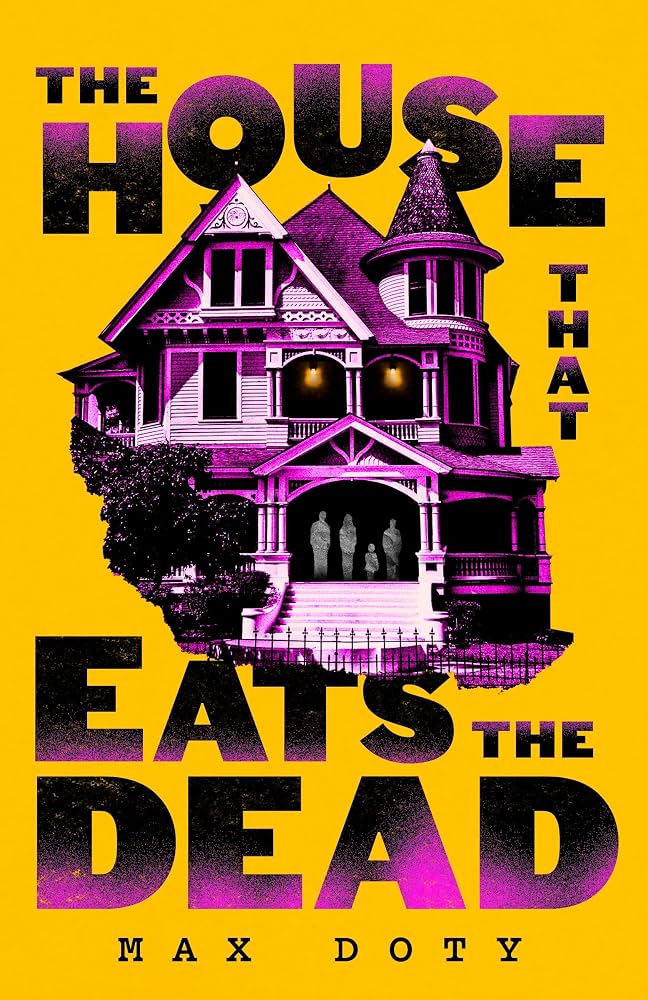
The House That Eats the Dead by Max Doty is a difficult one for me to review because, on the one hand, I genuinely appreciate what the author was trying to do with it. It’s a horror novel that attempts something a little different, which is always refreshing in a genre where certain ideas and tropes have been done to death. On the other hand, I couldn’t help feeling that there just wasn’t enough here to justify an entire novel, and by the time I reached the final page, I was left wondering what the point of it all had been.
That’s not to say it’s a bad book. Far from it. There are some interesting ideas here, and I certainly wouldn’t describe it as something I’ve read a hundred times before. The premise is unusual enough to grab your attention, and I always have a lot of respect for horror authors who are willing to experiment and try something outside the usual haunted houses, demonic possessions and masked killers. Horror is at its best when it takes risks, and I think Max Doty deserves some credit for attempting to do something a little more original.
Unfortunately, having an interesting idea and turning that idea into a satisfying novel are two very different things.
My biggest issue with The House That Eats the Dead is that it feels like a short story that’s been stretched out to fill a much longer book. There’s a decent concept at its heart, but once you’ve got your head around what’s happening, there really doesn’t seem to be much else for the story to do. Certain ideas and situations get revisited without adding anything particularly new, and I found myself waiting for the narrative to move forward.
I genuinely think this could have made a brilliant short story. Strip away some of the unnecessary material, tighten up the narrative, and focus on the central idea, and I suspect it would have been much more effective. There’s something to be said for knowing when a story has run its course, particularly in horror. Sometimes a concept works best when it’s introduced, explored and brought to a conclusion before the reader has too much time to pick it apart.
Not every interesting idea needs an entire novel to tell its story.
The other problem I had was just how predictable everything became. I’m not someone who needs every horror novel to have a massive twist or a shocking revelation at the end, but I do like to be surprised occasionally. I want the story to keep me guessing, or at least make me question where things might be heading.
Unfortunately, I felt as though I’d worked out where The House That Eats the Dead was going by about the halfway point.
Once I’d reached that stage, a lot of the tension disappeared. Rather than wondering what was going to happen next, I was mostly waiting for the characters to catch up with what I’d already figured out. There were moments when I hoped the author might throw in something unexpected, perhaps take the story in a completely different direction or reveal that I’d misunderstood something important. But for the most part, things played out pretty much as I’d anticipated.
That’s a shame because I think the premise deserved something a little more surprising.
Having said all that, I did keep reading, and I think that’s worth mentioning. Despite my frustrations with the pacing and predictability, I never quite reached the point where I wanted to abandon the book altogether. There was obviously something about it that held my attention, even if I can’t entirely put my finger on what that something was.
Perhaps it was the unusual concept. Perhaps I was hoping that the ending would deliver something that made the slower sections worthwhile. Or perhaps I was simply curious to see whether the author would manage to pull everything together in a way I hadn’t anticipated.
Whatever the reason, I kept turning the pages.
And I think that says something about the book. Even when I wasn’t particularly enjoying certain sections, there was enough of an underlying mystery to make me want to see it through. It’s just frustrating that the story never really capitalised on that potential.
Another issue, and probably the one that affected my overall enjoyment the most, was the characters.
I don’t need characters in horror novels to be particularly nice people. In fact, some of my favourite horror stories feature absolutely dreadful human beings. Flawed, selfish and downright unpleasant characters can be fascinating to read about, particularly when they’re placed in horrible situations. But there needs to be something about them that makes me care what happens, even if that something is simply a morbid fascination with how terrible they are.
Unfortunately, I didn’t really get that with this book.
I found the characters difficult to like, and I struggled to identify any particularly redeeming qualities that might have made me feel invested in their situations. They weren’t necessarily the sort of characters I loved to hate, either. I just didn’t find myself caring about them very much.
And that’s a pretty big problem when you’re reading horror.
For horror to work on an emotional level, I think you need some kind of connection with the people experiencing it. You need to feel frightened for them, sympathetic towards them, or at the very least interested in what happens to them. If you don’t care whether the characters survive, suffer or meet some terrible fate, then a lot of the tension simply disappears.
That’s exactly what happened to me here.
As the story progressed, I found myself becoming increasingly detached from the characters and their circumstances. Their decisions didn’t particularly surprise me, their personalities didn’t give me much reason to root for them, and I never really developed any emotional investment in their eventual fates.
By the time I reached the ending, rather than feeling shocked, disturbed, satisfied or even particularly disappointed, I found myself asking one very simple question.
‘So what?’
And I think that pretty much sums up my biggest problem with The House That Eats the Dead.
I’d finished the book. I’d followed the story through to its conclusion. I’d spent time with these characters and watched everything unfold. But when it was all over, I didn’t feel as though I’d taken very much away from the experience.
There wasn’t a particularly strong emotional impact, no lingering sense of dread, and nothing that really made me sit back and think about what I’d just read. It was simply over, and I moved on.
That’s probably the most disappointing thing about it because I genuinely believe there’s a good story buried somewhere in here. The central concept has potential, and the willingness to try something different is absolutely worth praising. I just don’t think the execution quite lives up to the idea.
I also think there’s a difference between a story being deliberately strange and a story being genuinely compelling. Something can be unusual, unsettling or experimental without necessarily being engaging, and while I appreciated the originality on display here, I often found myself wishing the author had done a little more with the concept.
Ultimately, The House That Eats the Dead is a book I wanted to like more than I actually did. I admire the attempt to bring something different to the horror genre, and I certainly don’t regret reading it. There was enough there to keep me interested until the end, which is why I don’t think it deserves an outright negative rating.
But the predictable direction, uneven pacing and largely unlikeable characters prevented me from becoming properly invested. And when the ending finally arrived, I was left feeling surprisingly indifferent about the whole thing.
I’m giving The House That Eats the Dead 3 stars. It’s an interesting and unusual horror novel with a decent idea at its centre, but one that ultimately feels stretched beyond what the story can comfortably support. There’s potential here, and I appreciate the ambition, but I can’t help thinking that a shorter, sharper version would have packed a much bigger punch.
Sometimes less really is more, particularly when it comes to horror.

