
⭐⭐⭐⭐
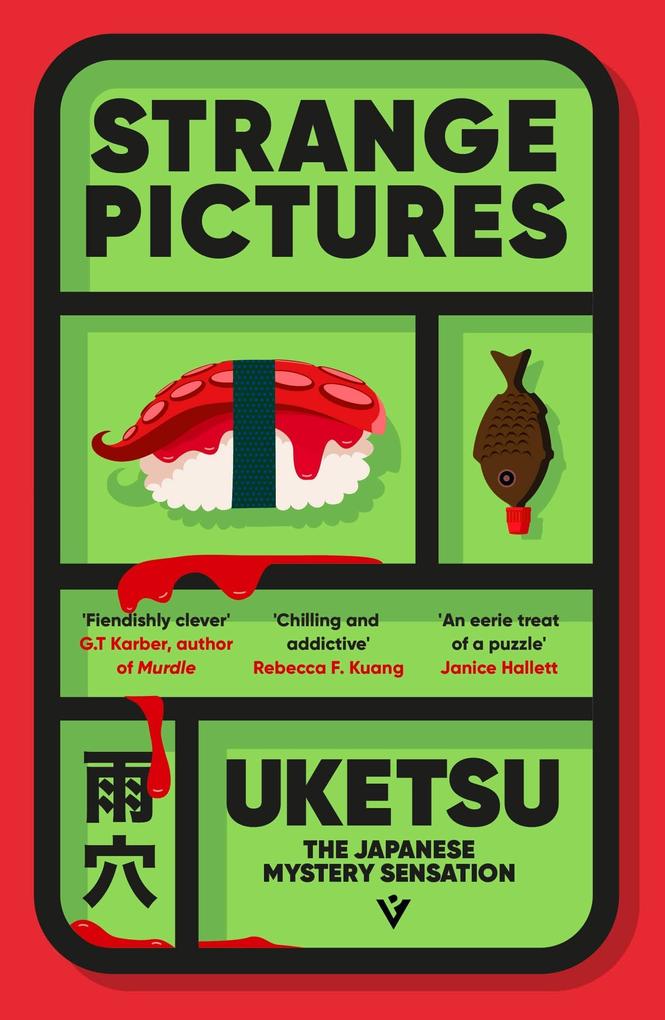
Strange Pictures by Uketsu is one of those books that I wasn’t entirely sure about for a good chunk of the story, but by the time I reached the final pages, I was completely hooked. It’s an unusual book with an interesting premise, and although I came dangerously close to losing interest around the halfway point, I’m glad I stuck with it because everything eventually comes together in a really satisfying way.
The main thing that attracted me to Strange Pictures was the concept itself. The idea of having actual images scattered throughout the book, with the mystery revolving around what those images might reveal, was something that immediately caught my attention. It’s not often you come across a novel that makes you examine illustrations for clues rather than simply reading the words on the page. The pictures aren’t just there to break up the text or make the book look interesting, either. They’re an essential part of the story, and you’re encouraged to study them, question what you’re seeing, and try to work out what they might mean.
I really liked that aspect of it. There’s something quite unsettling about looking at an otherwise ordinary drawing and knowing that there’s potentially something deeply disturbing hidden within it. It makes you pay attention to details you might otherwise overlook, and I found myself regularly flicking back through the pages to look at earlier images and see whether I’d missed something. It’s a clever way of telling a story, and one that makes the reading experience feel a little more interactive than your average mystery novel.
However, as much as I enjoyed the premise, I did struggle with the book for a while.
Without giving too much away, Strange Pictures is made up of several seemingly separate stories, each involving different characters, circumstances and, of course, mysterious images. Initially, I found this quite intriguing. I was interested to see where each story was heading and how the pictures would fit into everything. The problem was that, as I continued reading, I started to feel as though I was getting nowhere.
Just as I was becoming invested in one particular story, it seemed to end and move on to something completely different. Suddenly, I was being introduced to another set of characters and another mystery, with very little indication of how any of it connected to what I’d already read. It almost felt like I was reading a collection of short stories rather than a novel, and while there’s nothing wrong with that, I was expecting something a little more cohesive.
By the halfway point, I was genuinely starting to lose interest. I wouldn’t say I was bored exactly, but I was definitely confused. I couldn’t work out what the book was trying to do or where it was heading. There were all these interesting little mysteries being presented, but none of them seemed to be going anywhere. I kept waiting for something to happen that would tie everything together, and for quite a while, it felt as though that moment was never going to arrive.
I even started wondering whether I’d missed something important along the way.
Thankfully, I decided to keep going, because this is where Strange Pictures really started to win me over.
As the book moves towards its conclusion, those seemingly unrelated stories begin to connect, and suddenly things that had appeared completely insignificant earlier on start to take on a whole new meaning. Little details that I’d barely given a second thought to became important, and the pictures themselves began to make much more sense.
It was one of those wonderful moments where you realise the author has been laying the groundwork all along, and you’ve been too busy wondering what on earth is happening to notice it.
I absolutely loved the way everything gradually fell into place. What had initially felt like a rather disjointed collection of stories turned out to be something much more carefully constructed. Once the connections started becoming apparent, I found myself completely drawn into the mystery. All that frustration I’d felt earlier pretty much disappeared, and I was suddenly desperate to find out how everything was going to end.
In fact, the final section was easily my favourite part of the book. I went from struggling to maintain my interest to not wanting to put it down, which is quite an achievement considering how close I’d come to giving up on it.
Looking back, I can appreciate the earlier sections much more now that I understand what Uketsu was doing. The seemingly random nature of the stories is very much part of the experience, and I suspect that reading the book a second time would reveal all sorts of little clues and connections that I completely overlooked the first time around. It’s certainly the sort of novel that rewards you for paying attention, even when you’re not entirely sure what you’re supposed to be paying attention to.
My only other real issue with Strange Pictures was the writing itself. At times, I found some of the prose and dialogue a little stilted. There were moments when conversations didn’t feel particularly natural, and certain passages came across as slightly awkward or overly matter-of-fact. It wasn’t enough to ruin the experience, but it was noticeable, particularly during some of the earlier sections when I was already struggling to get invested in the story.
That said, I’m conscious that this is a book translated from Japanese into English, so I don’t know how much of that awkwardness comes from Uketsu’s original writing and how much might be a consequence of the translation. It’s entirely possible that certain nuances or rhythms of the original language don’t carry across particularly well. Whatever the reason, there were occasions when the writing felt a little flat, especially compared with how clever and intricate the actual story turned out to be.
I also wouldn’t necessarily describe Strange Pictures as an outright horror novel, despite some of the disturbing ideas running through it. For me, it sits much more comfortably somewhere between mystery, psychological horror and crime fiction. There are certainly unsettling moments, and some of the revelations are pretty grim, but the real appeal comes from trying to piece together the puzzle rather than being frightened by what’s happening.
And that’s ultimately what I enjoyed most about it. The book takes a fairly simple idea, a collection of strange drawings, and builds an increasingly complicated mystery around them. It asks you to question what you’re looking at, challenges your assumptions, and gradually reveals that there’s far more going on beneath the surface than you initially realise.
I do think it requires a little patience, though. If you’re someone who needs a clear narrative direction from the beginning, I can easily imagine the first half being frustrating. It certainly was for me. But if you’re willing to accept that you might spend a good portion of the book feeling completely lost, there’s a genuinely rewarding mystery waiting for you.
Ultimately, Strange Pictures was a bit of a rollercoaster for me. I started off intrigued, became increasingly confused and frustrated, and then ended up thoroughly enjoying myself once everything began falling into place. It’s not a perfect book, and I still think some of the writing could have been smoother, but I can’t deny how impressed I was by the way Uketsu managed to bring all those seemingly disconnected threads together.
What initially felt like the book’s biggest weakness ended up becoming one of its greatest strengths.
I’m giving Strange Pictures a very solid 4 stars. It’s a clever, unusual and ultimately satisfying mystery that makes excellent use of its illustrations. It nearly lost me halfway through, but by the end I was completely invested. I’m glad I persevered, and I’d definitely be interested in reading more of Uketsu’s work.
Just be prepared to spend a fair amount of time wondering what the hell is going on. Thankfully, that’s rather the point.

