
⭐⭐⭐
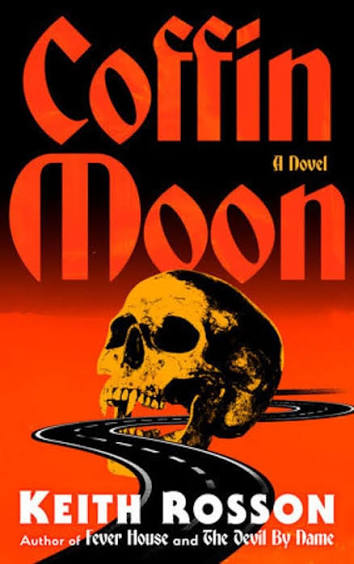
I’d seen quite a bit of hype surrounding Coffin Moon by Keith Rosson before picking it up. Plenty of people seemed to be singing its praises, and it sounded like exactly the sort of book I’d enjoy. So, naturally, I went into it with fairly high expectations. Unfortunately, having now finished it, I’m left wondering what all the fuss was about.
That’s not to say it’s a bad book. It isn’t. It’s just a very average one, and I think that’s what makes it so disappointing. There’s nothing particularly terrible about it, but there’s also very little that makes it stand out. It’s a story that feels like it’s been told plenty of times before, and while there’s absolutely nothing wrong with taking familiar ideas and putting your own spin on them, I never really felt that Coffin Moon brought anything especially new or interesting to the table.
One of my biggest problems with the book is the pacing. There are stretches where it feels like the story is barely moving forward at all. Things happen, characters have conversations, decisions are made, but it often feels as though we’re not actually getting anywhere. Then, just when you think something significant is about to happen, the narrative seems to wander off in another direction or spend far longer than necessary getting to the point.
And when it isn’t dragging, it feels like it’s going round in circles.
There were several occasions when I found myself thinking that we’d already covered a particular bit of ground, only for the story to return to it again. The same sort of situations, the same general ideas, and the same sense that something bigger is coming without ever quite getting there. After a while, it becomes frustrating rather than intriguing. I don’t mind a slow burn. In fact, some of my favourite horror novels take their time building atmosphere and tension. But there’s a difference between deliberately taking your time and simply taking too long to tell a story.
For me, Coffin Moon falls into the latter category far too often.
I think what makes this particularly frustrating is that there are the ingredients of a much better book here. There are moments when things start to pick up, when the atmosphere works and when you get a glimpse of what the story could have been. Rosson can certainly write, and I don’t think the problem is a lack of ability. It’s more that the book never seems to find a consistent rhythm. Every time I started getting properly invested, something would happen to slow everything down again.
I also struggled with how familiar everything felt. Obviously, horror is a genre that regularly revisits the same themes, monsters and ideas. That’s part of its appeal, and I don’t expect every book to reinvent the wheel. But I do want something that makes a story feel like its own thing. A different perspective, an unexpected direction, an interesting twist on an old idea. Something.
Unfortunately, I never really got that here.
Instead, I spent much of the book waiting for it to do something that would justify all the praise I’d seen. There was this constant feeling that surely something was coming that would make everything click into place. That all the slower sections and repeated beats were building towards something genuinely memorable.
And that brings me to probably my biggest disappointment with the entire book: the payoff.
It feels as though practically the whole novel is building towards one particular confrontation or moment. So much time is spent getting the characters into position, establishing the stakes and making it clear that this is where everything is heading. You expect something substantial after investing so much time in reaching that point.
And then, when it finally arrives, it’s all over in what feels like a couple of pages.
That’s it.
No great fanfare. No particularly satisfying sense of release after everything that has come before. Just a surprisingly brief conclusion to something that has taken an entire book to reach. I actually found myself wondering whether that really was all we were getting.
I’m not suggesting that every horror novel needs an enormous, action-packed finale. Sometimes an understated ending can be far more effective than something loud and dramatic. But an understated ending still needs to feel earned, and this one just didn’t deliver the satisfaction I was hoping for. After spending so much time building towards it, the whole thing felt strangely rushed.
It’s an odd contrast, really. So much of the book feels unnecessarily drawn out, yet the part that arguably deserves the most attention seems to be dealt with in a hurry. I couldn’t help thinking that a little less time spent going over familiar ground and a little more time devoted to the conclusion would have made for a much more satisfying experience.
I think the hype probably did this book a few favours in getting me interested, but absolutely none when it came to actually reading it. Had I picked it up knowing nothing about it, perhaps I’d have been a little more forgiving. But when you’ve seen so many enthusiastic recommendations, you naturally start expecting something special. And for me, Coffin Moon simply isn’t that.
There are certainly worse books out there, and I never reached the point where I seriously considered giving up on it. There was enough to keep me reading, even if some of that motivation came from wanting to see whether the ending would make the journey worthwhile. Unfortunately, it didn’t quite manage that either.
Ultimately, Coffin Moon is a perfectly serviceable horror novel that never really rises above being just that. It’s competently written, has some decent moments and isn’t without its merits, but it’s also overlong in places, repetitive in others and disappointingly brief when it finally reaches what should be its big moment.
Perhaps other readers will find something in it that I missed. Judging by the amount of praise it’s received, plenty already have. And that’s fair enough. Not every book is going to work for every reader.
For me, though, this was a fairly forgettable experience. I didn’t hate it, but I didn’t particularly love it either. It occupied my time without ever really grabbing me, and I can’t imagine it’s a story I’ll find myself thinking about much now that I’ve finished it.
Three stars feels about right. Not bad, not great, just thoroughly average. And given the amount of hype surrounding it, that’s probably the most disappointing thing of all.

