
⭐⭐⭐⭐⭐
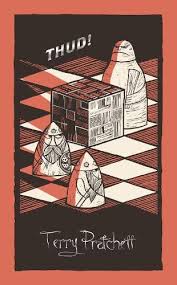
I’ve been slowly making my way back through the Discworld books, and every time I return to the City Watch novels, I remember why they’re some of my favourites. Thud! might honestly be one of the strongest of the lot. It’s funny, angry, clever, absurd, surprisingly emotional, and somehow manages to balance a murder mystery, political tension, ancient dwarf grudges, and a children’s bedtime book all at once without ever feeling bloated.
And at the centre of it all is Sam Vimes, who I genuinely think is one of the best fictional characters ever written. Sam Vimes has gone from being this exhausted, drunk captain in earlier books to someone carrying the entire weight of the city on his shoulders, and yet he still feels grounded and human. In this one especially, there’s this constant pressure pulling at him from every direction. He’s trying to stop a war before it starts, solve murders, navigate political chaos, and still get home in time to read Where’s My Cow? to his son every night. Somehow, that recurring bedtime story becomes one of the most tense and emotional parts of the whole book.
What really stood out to me on this reread was how sharp the themes are beneath all the comedy. Terry Pratchett was always brilliant at taking fantasy concepts and using them to talk about very real things, and Thud! dives hard into inherited hatred, extremism, nationalism, and the stories societies tell themselves to justify violence. The dwarf and troll conflict could have easily been simplistic fantasy worldbuilding in another writer’s hands, but Pratchett makes it feel painfully believable. There’s history there, bitterness, identity, religion, politics — and every side thinks they’re completely justified.
At the same time, the book never stops being funny. That’s the thing Pratchett was so unbelievably good at. One page, you’re laughing at Nobby Nobbs being deeply suspicious in entirely the wrong direction, and the next, you get hit with something genuinely profound. The humour never undercuts the serious moments either. If anything, it makes them land harder because the world feels alive and full of ridiculous people muddling through impossible situations.
The Watch themselves are brilliant here, too. By this point, they really feel like a dysfunctional family more than a police force. Carrot remains endlessly earnest in a way that should be annoying but somehow never is. Angua and Sally bouncing off each other is fantastic. Detritus gets some genuinely great moments. Even minor characters feel memorable because Pratchett could sketch an entire personality in a couple of lines.
And then there’s “The Summoning Dark”, which adds this almost horror-like edge running underneath everything. Some of the scenes involving Vimes losing himself to rage are genuinely unsettling. Pratchett understood that Vimes isn’t a hero because he’s naturally good — he’s a hero because he constantly fights the darker parts of himself. That’s what makes him compelling.
The pacing is also surprisingly strong considering how much is going on. The mystery element keeps things moving, but the real hook is just spending time in Ankh-Morpork again. It’s one of those fictional cities that feels completely real by this point in the series. Chaotic, filthy, dangerous, absurdly bureaucratic, and full of life.
I also think this is one of the Discworld books that benefits massively from already knowing the characters. It feels like the culmination of so much development across the Watch series. Seeing where Vimes has ended up compared to where he started genuinely hit harder this time around.
There are fantasy books that build giant worlds full of lore and maps and histories, but Discworld always felt different to me because it understood people first. Beneath the trolls, dwarfs, assassins, werewolves, and undead lawyers, these books are about humanity. Or in Discworld terms, about “people” in the broadest possible sense.
By the end, I was reminded why Pratchett’s books stick with so many readers. They’re entertaining, yes, but they’re also compassionate in a way that never feels naïve. Thud! is angry about prejudice and violence, but it still believes people can be better than their worst instincts.
And honestly, that final stretch with Vimes trying to get home on time? Somehow more tense than most thrillers I’ve read.
An easy five stars for me. One of the absolute best Watch books, and one of the clearest examples of why Terry Pratchett was such a special writer.

