
⭐⭐⭐⭐
Burning Midnight by Will McIntosh was a really enjoyable read, and one that managed to keep me interested pretty much from beginning to end. It’s got an interesting premise, some great ideas, and, perhaps most importantly, it knows how to keep things moving without making you feel as though you’re being dragged from one plot point to the next. It’s not a perfect book, and there were a few things I would have liked to see handled differently, but overall, I had a great time with it.
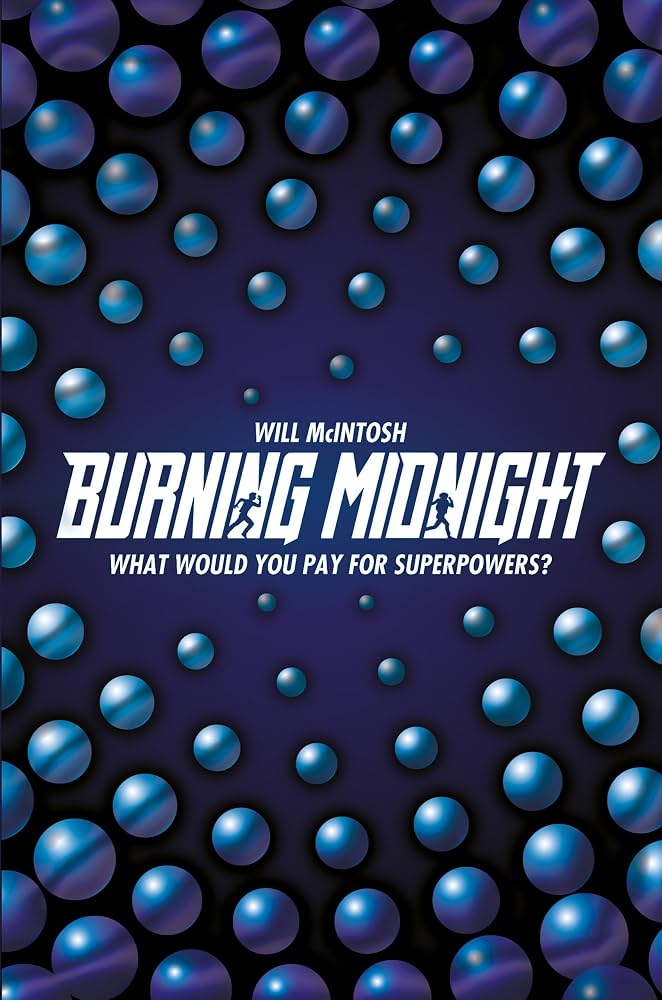
The premise is probably one of the book’s biggest strengths. Mysterious coloured spheres have appeared all over the world, and nobody really knows where they’ve come from or why they’re there. What people do know is that collecting and burning pairs of them can give you certain abilities or improvements, depending on their colour. Naturally, humanity being humanity, this has turned into an entire economy, with rare spheres fetching ridiculous amounts of money and people going to extraordinary lengths to get their hands on them. It’s a fascinating idea, and one that immediately opens up all sorts of questions about greed, inequality, obsession, and what people are willing to do to improve their lives.
What I particularly liked was how McIntosh takes something so bizarre and makes it feel like a perfectly believable part of everyday life. The spheres have become normalised to the point where people barely question their existence anymore. They’re just another commodity, another way for the wealthy to get wealthier, and another thing for everyone else to dream about. There’s something quite amusing, and perhaps a little depressing, about how quickly humanity has managed to turn a worldwide mystery into a commercial enterprise.
For me, though, the pacing is where this book really shines. It’s absolutely spot on. There are very few moments where things feel as though they’re dragging, but equally, it never feels like the author is rushing to get to the next big revelation. There’s a really nice balance between the quieter moments, where we’re learning more about the characters and the world they inhabit, and the more action-heavy sections where things start getting increasingly complicated.
I’ve read plenty of books with interesting premises that eventually lose themselves somewhere in the middle, either because the author spends too long explaining everything or because the story seems to run out of steam. Thankfully, that never really happened here. McIntosh does a great job of introducing new information at just the right moments, giving you enough to keep you interested without revealing too much too soon. Every time I thought I had a decent understanding of where the story was going, something else would happen to make me reconsider things.
It’s also a genuinely easy book to get through, and I mean that as a compliment. There’s nothing particularly demanding about the writing, but it doesn’t need to be. The prose is straightforward, the story is engaging, and the chapters move along at a pace that makes it incredibly tempting to keep reading just a little bit longer. It’s the sort of book where you sit down intending to read for twenty minutes and suddenly realise you’ve been there for considerably longer.
Where I think the book falls a little short, however, is with its characters.
Don’t get me wrong, I didn’t dislike them. In fact, I thought they were perfectly decent characters to follow, and I was interested in seeing what happened to them. But I couldn’t help feeling that they could have been given a little more depth. There were moments when I wanted to know more about what was going on beneath the surface, particularly when they were faced with decisions that should have carried quite a lot of emotional weight.
Sometimes it felt as though the characters existed primarily to move the plot forward rather than being fully realised people with complicated motivations and personalities. Their actions generally made sense within the context of the story, but I didn’t always feel particularly connected to them. I understood what they were doing and why they were doing it, but I wasn’t necessarily feeling everything alongside them.
And that’s a shame, because I think a little more time spent developing their personalities, relationships, and internal conflicts could have elevated the book considerably. There are some genuinely interesting situations here, and plenty of opportunities to explore how ordinary people might react when confronted with something extraordinary. The book touches on those ideas, but I would have liked it to dig a little deeper.
That said, I also recognise that spending considerably more time on character development might have affected the pacing, which, as I’ve already mentioned, is one of the things I enjoyed most. Perhaps it’s a case of wanting to have my cake and eat it, but I do think there’s a middle ground where the characters could have felt a little more substantial without slowing everything down.
Another thing I appreciated was that the book doesn’t immediately explain every aspect of its world. There’s a sense of mystery running through the story that makes the whole thing much more interesting. The spheres are such a strange concept, and the fact that society has largely accepted them without fully understanding them adds another layer to the story. I liked discovering more about them as the characters did, rather than being given a massive explanation at the beginning.
And then there’s the ending.
Without getting into spoilers, the final part of the book went in a direction I genuinely wasn’t expecting. I’d developed a few theories about where everything might be heading, and while I wasn’t necessarily expecting all of them to be correct, I certainly didn’t anticipate the particular route McIntosh decided to take.
It’s quite a significant shift, and I can absolutely understand why it might divide readers. Depending on what you’ve enjoyed most about the story up to that point, I imagine the ending could either feel like a brilliant payoff or something of a departure from what you thought you were reading.
For me, it landed somewhere in the middle, although definitely leaning towards the positive. Was it the ending I would have chosen? Probably not. Was it what I was expecting or even particularly hoping for? Again, no. But was I angry about it? Not at all.
In fact, I rather appreciated that McIntosh was willing to take the story somewhere unexpected instead of simply delivering the most obvious conclusion. There are certainly arguments to be made about whether every aspect of it works, and I did find myself thinking about some of the decisions afterwards, but I’d much rather have an ending that gives me something to consider than one that feels entirely predictable.
I think my only real reservation is that the ending changes the way you look at quite a lot of what came before it, and I’m not completely convinced that every element of that shift was as satisfying as it could have been. But it didn’t ruin the experience for me, and it certainly didn’t make me regret reading the book. If anything, it made me appreciate just how ambitious the overall concept was.
Ultimately, Burning Midnight is a really entertaining science fiction novel built around a fantastic premise. It has a world that feels surprisingly believable despite its ridiculous central concept, a mystery that develops nicely, and pacing that I honestly can’t fault. The characters could have done with a little more work, and the ending might not be to everyone’s taste, but neither of those things was enough to significantly diminish my enjoyment.
It’s not necessarily a book that’s going to stay with me because of its characters or its emotional impact, but I can certainly see myself remembering the premise for a long time. There’s something wonderfully imaginative about the whole idea, and I enjoyed seeing how McIntosh explored its implications.
Four stars from me. A clever, fast-moving and thoroughly enjoyable read that doesn’t quite reach its full potential in terms of character development, but more than makes up for it with an intriguing mystery, excellent pacing, and an ending that, whether you love it or not, certainly gives you something to think about.

