

⭐⭐⭐⭐⭐
After being pretty disappointed with Snuff, I went into Raising Steam hoping it would feel like Discworld getting back to its usual self, and thankfully, it really did. This felt much more like the Pratchett I love: funny, clever, warm, slightly ridiculous, and packed with observations about people and society without ever forgetting that it’s supposed to be entertaining.
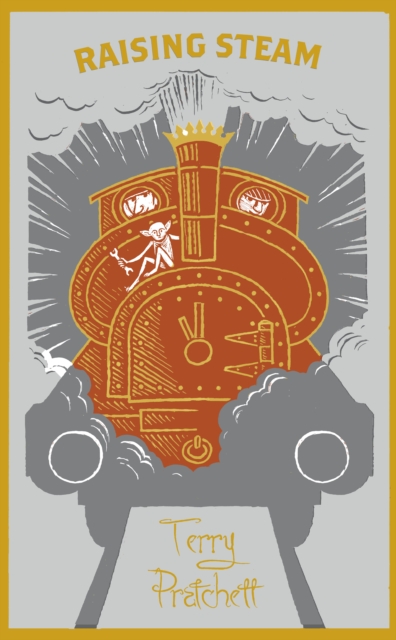
The big change this time is the arrival of the railway. Dick Simnel has built a steam engine, and before long the possibilities of this new invention become impossible to ignore. Lord Vetinari certainly sees them, Moist von Lipwig gets dragged into things, and Discworld suddenly finds itself having to deal with something capable of completely changing the way people travel, trade and communicate.
I really liked the way Pratchett handles the railway because it isn’t simply dropped into Discworld as a new bit of technology. You actually get to see the world reacting to it. Some people are fascinated, some see the money it can make, some are suspicious, and others see change itself as dangerous. That makes the whole thing feel much bigger than just a story about trains. It’s about progress arriving whether everyone is ready for it or not.
And, because this is Discworld, progress is never straightforward.
Moist von Lipwig is exactly the right character to be stuck in the middle of all this. He’s still a conman at heart, even if these days he mostly uses those talents in slightly more respectable ways. Watching him try to manage people, publicity, politics and the increasingly complicated railway system is great fun. He has that wonderful ability to look like he knows exactly what he’s doing while internally trying to work out how everything has gone so badly wrong.
Vetinari is also brilliant throughout. I love the way he can seemingly say very little while making it perfectly clear that he already knows what everyone else is going to do. His relationship with Moist remains one of my favourite things about the later Discworld books. Moist knows perfectly well that Vetinari is manipulating him, Vetinari knows that Moist knows, and somehow Moist still ends up doing exactly what Vetinari wanted in the first place.
There are loads of familiar faces scattered throughout the book too, and that was another reason this felt like such a return to form after Snuff. Ankh-Morpork feels alive again. The Watch, Harry King, the Patrician, the dwarfs, the goblins and all the various people caught up in the railway give the story that wonderfully busy Discworld feeling where there always seems to be something happening just around the corner.
The goblins in particular remain a really interesting addition to the later books. Pratchett uses them to explore prejudice and the way societies decide who gets to be considered a person, but here they feel more naturally woven into the wider world than they did for me in Snuff. The themes are still there, but they sit alongside the story rather than overwhelming it.
A darker side also runs beneath all the excitement about the railway. Not everyone welcomes the way Discworld is changing, particularly among the dwarfs, and that gives the book a conflict that goes beyond whether the railway itself will succeed. Pratchett has always been good at writing about people who become obsessed with the idea that there was some better, purer version of the past, and Raising Steam gives him plenty of room to explore that.
What I particularly enjoyed, though, was the sense of momentum. Once the railway starts spreading, the book feels as though the entire Disc is moving with it. Towns become connected, journeys that once seemed enormous suddenly become possible, businesses change, people meet who might never have met before, and the world becomes just a little bit smaller.
There’s something quite lovely about that.
It also feels very Discworld that this enormous technological revolution begins because somebody looked at steam power and essentially thought, “I wonder what happens if I put this on wheels?” From there, everyone else starts figuring out what it means afterwards. Innovation first, consequences later.
The humour worked much better for me here too. There are plenty of terrible jokes, misunderstandings, bits of wordplay and little throwaway lines that made me stop and laugh. That was probably what I missed most while reading Snuff. I know plenty of people love that book, but personally it just didn’t click with me and I finished it feeling disappointed. With Raising Steam, I felt like I was properly enjoying Discworld again.
There is admittedly a slightly different feeling to some of the later books compared with Pratchett at his absolute peak. Certain passages are a bit more direct, and occasionally characters explain things more than I remember them doing in earlier novels. But none of that stopped me enjoying it. If anything, knowing this is so close to the end of the Discworld series gives all the talk about change, progress and the future an extra emotional weight.
That was probably what stayed with me most after finishing it.
Discworld has changed enormously since The Colour of Magic. What started as a parody of fantasy became this huge, complicated world full of politics, newspapers, banks, post offices, police forces, technology and people constantly trying to drag society forwards while somebody else desperately tries to pull it backwards. Raising Steam feels almost like Pratchett looking at everything the Disc has become and giving it another push towards the future.
And yet, despite all that change, it still feels unmistakably like Discworld.
It’s funny, chaotic, thoughtful and full of characters I’ve become ridiculously attached to over the course of the series. There’s something wonderfully satisfying about watching the railway stretch across the Disc and knowing that the world isn’t standing still.
After my disappointment with Snuff, this was exactly what I wanted. It felt like Discworld was back to its usual strange, clever, hilarious self, and I had a great time with it.

