

⭐⭐⭐⭐
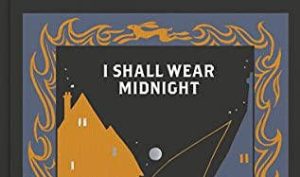
I’ll admit, I wasn’t completely sold on I Shall Wear Midnight when I first started it. I went into this one expecting to enjoy it because it’s Terry Pratchett, it’s Discworld, and it’s another Tiffany Aching story, but for quite a while I found myself wondering where exactly the book was going. It felt like it took a little too long to get going, with a few false starts and different threads introduced without me being entirely convinced they were going anywhere.
And yet, somewhere along the way, it clicked.
I probably should have had more faith in Pratchett from the beginning.
This is the fourth book centred around Tiffany Aching, and by this point Tiffany has grown considerably from the young girl we met earlier in the series. She’s becoming a proper witch, but Pratchett’s witches have never really been about waving a wand around and throwing impressive spells at people. Being a witch is much more about helping people, dealing with problems, knowing when to interfere and, perhaps most importantly, doing the things that nobody else wants to do. Tiffany is very much learning what that actually means.
That’s something I really like about these books. Tiffany isn’t a perfect hero. She can be stubborn, she can be a bit too confident in her own judgement, and she’s still young enough to make mistakes. But she genuinely cares about people. Even when those people are unpleasant, difficult or downright horrible, she still feels a responsibility towards them. There’s something very Pratchett about making the heroic thing less about defeating a monster and more about turning up when somebody needs help.
The story itself is also considerably darker than some of the earlier Tiffany books. There’s a real sense of nastiness creeping into the world, particularly in the way people begin turning against witches and allowing fear and prejudice to take over. Pratchett was always very good at taking something ridiculous or fantastical and using it to say something uncomfortably accurate about the real world, and there’s plenty of that here.
The idea of encouraging people to hate something they previously accepted works particularly well because it doesn’t feel like a simple “evil wizard makes everyone evil” plot. There’s something much more human about it. People already have their prejudices and their fears; all that’s needed is someone or something to give them a push.
And then there’s the humour.
It wouldn’t be Discworld without it, and while I don’t think this is quite as consistently funny as some of my favourite Discworld novels, there are still plenty of moments where I found myself laughing at the sheer absurdity of what Pratchett was doing. The Nac Mac Feegle are, of course, always good for some ridiculousness, and having Tiffany surrounded by characters who are essentially tiny, blue, violent Scottish stereotypes remains one of those ideas that shouldn’t work nearly as well as it does.
There are also appearances from some familiar faces, and I always enjoy the way the Tiffany books connect her story to the wider Discworld. It makes the world feel much bigger than whatever immediate problem Tiffany happens to be dealing with. Granny Weatherwax in particular is always a welcome presence, and there’s something great about seeing Tiffany interact with the older witches as she gradually establishes herself.
What did hold this back for me was the pacing.
As I mentioned at the start, I just wasn’t sure about it for a while. There are sections that feel as though they are setting something up without quite knowing where they are going, and I find myself waiting for the various pieces to start fitting together. There were moments where I thought, “Okay, but what’s the point of this?” only to eventually realise that Pratchett was quietly laying the groundwork for something that would become much more important later.
That was probably my biggest problem with the book. It isn’t that nothing happens, because plenty does. It’s more that the story doesn’t immediately give you that feeling of momentum that some of the best Discworld novels have. It takes its time establishing Tiffany’s situation, the wider threat and the various characters involved.
But then the final part arrived, and suddenly I understood what Pratchett had been doing.
Everything started coming together.
And that’s probably why I ended up giving this four stars rather than three. If I’d judged the book purely on how I felt during the first half, I might have been considerably less generous. But the further I got into it, the more the different threads began to make sense, and by the end I was genuinely glad I’d stuck with it.
It also helps that Tiffany is such a great character to follow. There’s a sense that she’s finally starting to understand what being a witch really means, and that makes this feel like an important stage in her development. She’s not simply learning magic. She’s learning responsibility, compassion and what it means to stand between ordinary people and something they don’t understand.
And, as always with Pratchett, there’s far more going on beneath the jokes than you might initially expect.
I Shall Wear Midnight is funny, but it’s also angry. It’s about fear, prejudice, scapegoating and the ease with which ordinary people can be persuaded to turn against someone. It’s about how rumours can become accepted as fact and how quickly people can forget all the good someone has done when they’ve been given a reason to dislike them.
Those themes make the darker tone work really well. This isn’t simply a Tiffany Aching adventure where she goes off, fights the bad thing and comes home again. There’s a much stronger sense of consequence to everything that happens, and Tiffany has to deal with the fact that being a witch means sometimes being hated by the very people she’s trying to help.
And despite my problems with the beginning, I think the ending is where the book really proves itself.
I had spent much of the earlier chapters wondering whether all these different elements would come together properly. By the time I reached the end, I realised that I should have trusted Pratchett to know exactly what he was doing. It isn’t necessarily the most straightforward Discworld book, but the payoff is there.
It’s also another good example of why I like the Tiffany Aching books so much. They may technically be aimed at younger readers, but Pratchett never seems interested in talking down to his audience. He can tackle some surprisingly dark and uncomfortable subjects while still making room for jokes, absurd characters and genuinely warm moments.
Tiffany herself is probably the biggest reason this works. She’s grown into a really strong Discworld protagonist, and I like that her strength doesn’t come from being the most powerful person in the room. More often than not, it comes from simply refusing to walk away when somebody needs her.
So, while I Shall Wear Midnight didn’t grab me immediately and definitely had a few moments where I wasn’t entirely convinced by the direction it was taking, I’m glad I stuck with it. The occasional false starts and slower sections stopped this from becoming a five-star read for me, but once everything started coming together, I found myself appreciating what Pratchett had been building towards.
I probably should have had more faith.
It’s Terry Pratchett, after all.
Onto the next.

