
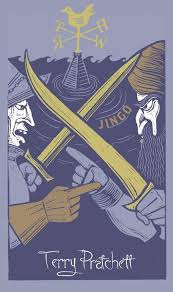
Jingo is one of those Discworld novels that sneaks up on you. You go in expecting a fairly straightforward bit of satire — nationalism, flag-waving, the absurdity of war — and you get all that, but you also get something sharper and more uncomfortable than it first appears.
On the surface, the plot is classic Pratchett chaos: a new island pops up between Ankh-Morpork and Klatch, everyone immediately decides it’s theirs, and suddenly people who’ve never met a Klatchian in their lives are very sure they’re dangerous, untrustworthy, and probably deserve whatever’s coming to them. It’s funny in the way Discworld usually is, full of running jokes, wordplay, and situations that spiral neatly out of control. But there’s a real bite underneath the humour here.
What really stands out is how clearly Pratchett understands how quickly ordinary people can be nudged towards conflict. Nobody in Jingo really wants a war at first — they just want to be right, to belong to the correct side, to feel clever and morally justified. The way slogans replace thought, and how “us versus them” thinking spreads like a social infection, feels uncomfortably familiar, even now. Possibly especially now.
Vimes is on top form here. His deep suspicion of patriotism-as-performance, and his refusal to accept neat, heroic narratives about war, ground the whole book. He’s grumpy, principled, and painfully aware of how thin the line is between maintaining order and becoming part of the machinery that creates violence. His internal struggle — trying to stop things escalating while everyone else seems keen to march — gives the story real emotional weight.
The supporting cast are great too. Colon and Nobby are used brilliantly to show how propaganda works on the ground level, and Leonard of Quirm is a perfect example of how invention and intelligence can be both wondrous and terrifying depending on who’s holding the reins. Even the more broadly comic elements never feel wasted; they’re always doing thematic work, even when they’re being ridiculous.
It’s not the tightest Discworld plot in terms of structure — it wanders a bit, and some sections feel more interested in making a point than advancing the story — but that feels almost appropriate given the subject matter. Wars don’t start cleanly or logically, and neither does this book. The messiness is part of the argument.
Overall, Jingo is funny, angry, thoughtful, and surprisingly bleak beneath the jokes. It’s Pratchett at his most openly political, but also at his most humane. You laugh a lot while reading it, then find yourself thinking about it afterwards, which is arguably when Discworld is at its best.
 Gareth Ellis - Author