
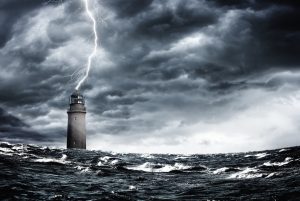
The lighthouse didn’t have a name anymore. Whatever plaque once declared it proud and useful had rotted away decades back, leaving only its jagged silhouette jutting from the rocks like a finger pointing at something no one else could see. Locals called it the Needle because it skewered the sky; thin, stark, and unnaturally tall against the slate-grey horizon of the northern sea.
It wasn’t a place for tourists. Even birds avoided it, circling wide as if its shadow chilled their wings. The fishermen who sailed near kept their eyes elsewhere, muttering that their compasses spun like broken clocks whenever they drifted too close. All of that suited Evan just fine. Solitude was exactly what he wanted.
He’d taken the post after a messy break-up and weeks where sleep slipped out of reach like a crab scuttling between rocks. A month alone in the Needle felt like a refuge, routine, fresh air, and the rhythmic peace of the lamp turning through the night. When the company boat deposited him at the base, just shy of sunset, the boatman pressed the key into his palm and refused to linger.
“Keep that lamp burning,” the man said without meeting his eye. Rain freckled his face, the sea clawing at the hull behind him. “Whatever you do… don’t let it go dark.”
He didn’t wait for a reply. The engine sputtered, the boat turned, and Evan was alone. Properly alone.
He climbed towards the lighthouse door, the stone steps slick with moss and old storms. Each step squelched, his boots sticking as though the island had grown fond of its previous inhabitants and wasn’t sure about letting another one leave. The metal door resisted at first, then swung open with a long, low groan, like the tower resented being disturbed.
Inside, the air was stale and wet. Salt crusted the brickwork; the spiral staircase rose in the centre like the spine of some great beast, its metal railings streaked with rust the colour of dried blood. Every sound echoed: the drip of water, the shuffle of his boots, the distant booming of the sea battering the rocks below.
The first few nights felt easy. The isolation suited him. He drank cheap tea, read old sea journals left behind by previous keepers, and listened to the wind drag its claws along the bricks. The lamp at the top swung its bright arm across the waves, slicing through the dark like a blade. He always checked it before bed—steady, strong, reassuring.
On the third night, the knocking started.
At first, it seemed like part of the storm, wind snapping shutters or waves striking lower stonework, but the rhythm didn’t match nature’s chaos. Three knocks. A pause. Three more.
He froze halfway down the stairs, listening. The sound rose from the door at the base, precise and patient. He tried to tell himself someone needed help, even though the nearest town was almost twenty miles by water and no sane boatman would approach in that weather. Guilt gnawed at him anyway.
He descended with a hollow stomach. When he pressed his hand to the door, the knocks stopped. The silence was thick, as if something were holding its breath on the other side.
He unbolted the lock and pulled the door open a crack.
Only darkness waited. A wall of black rain. The taste of cold salt slapping his face. No footprints. No lantern light. No voice calling for help.
He shut the door. As he stepped away, the knocking began again, this time softer, as though the knocker had moved slightly to the left… sinking deeper into the wall.
By the next evening, the knocks had shifted. They came from the stairwell. Then from the small kitchen. Then, chillingly, from the trapdoor leading to the lantern room. Always in threes. Always spaced the same. Evan tried blasting music through an old speaker, but the knocks slipped between notes like fingers sliding under a door.
On the fifth night, he found the first smear.
In the lantern room, just inside the glass, a wet handprint glistened. Its fingers were far too long, thin as twigs, each one a little crooked. The print was fresh, droplets running down the glass like sweat. Evan wiped it away with a cloth, trying to laugh it off. Condensation. A trick of the light. Anything but what it looked like.
The next night, there were three handprints, lower down, as if something had crouched there, watching him sleep.
By now, he barely slept at all. Even when he dozed off at dawn, he woke with the sense that someone had been standing beside him. Listening. Counting his breaths.
The lamp began to dim as well, flickering at odd intervals. Once, as he reached the top of the stairs, he thought he saw a shape against the outside of the glass, too still, too tall, but the light steadied, and the darkness swallowed whatever had been there.
On the ninth night, a storm like nothing he’d ever experienced pounded the island. The sea roared like it meant to swallow the rocks whole. The entire lighthouse trembled with each wave’s impact. Evan sprinted to check the lamp, knowing the storm demanded every scrap of brightness to keep ships safe—even if none ever sailed this far out anymore.
He reached the top and froze.
The lantern room door stood open.
He remembered closing it. He always closed it.
A trail of water led inside, dripping in a thin, shining line. It didn’t look like rainwater. It was thicker. Almost oily. It glistened like something fresh pulled from the deep.
The great lamp was barely lit now, its glow pulsing as though something were draining it. The shadows in the room felt too heavy, too solid. Evan followed the wet trail to the far window.
A face stared at him through the glass.
Bloated, pale, swollen by the sea. The skin sagged like soft wax. Its eyes were round and lidless, white as a moon behind fog. Seaweed matted its scalp, floating gently, though there was no water on this side of the lens. It pressed its face to the glass, leaving streaks as it breathed—or imitated breathing.
Long, colourless fingers scraped symbols into the condensation. The scratches sounded like tiny screams.
Evan staggered back, and as he did, another face rose beside the first. And another. And another. A crowd of drowned things hovered just beyond the lighthouse’s fragile boundary, their shattered mouths warped into wide, black smiles. Their arms drifted like kelp, fingertips rasping the glass with slow, rhythmic intent.
The knocking began again, three sharp taps, this time from every window in the lantern room at once.
Panicked, Evan lunged for the controls, trying to force the lamp brighter. Sparks spat. Something hissed. The rotating mechanism sputtered and jammed. The storm shrieked outside, but the sound inside the tower drowned everything out: dozens of fists tapping, demanding, begging the light to fail.
The temperature plummeted. Frost webbed across the inner glass. Evan’s breath came out in shivering clouds. The lamp guttered, weaker, weaker still.
The final thing he saw before the light died completely was one of the creatures dragging its long, skeletal arm around the lens, wrapping its fingers like a lover reaching for a cheek.
When the lamp blinked out, the knocking stopped.
And the glass broke inward.
They found the lighthouse a month later when the company sent a new keeper. The boatman refused to step onto the rocks. He stopped a good ten metres out, shouting that no job was worth landing there.
From the cliffs, the new keeper saw that the lamp was dark, and the door hung crooked, scraping the stone with every gust. Inside, the stairs were soaked, seaweed clinging to each step, as if something had slithered up them.
In the lantern room, the glass panes were cracked from the inside.
And in the walls—each soaked brick carried a faint, rhythmic tapping, like something deep in the foundations was still knocking. Three times. Always three. Waiting for another keeper to bring the light back, just long enough for them to come again.
Image from: https://www.sailingeurope.com/blog/horror-at-the-lighthouse
 Gareth Ellis - Author