
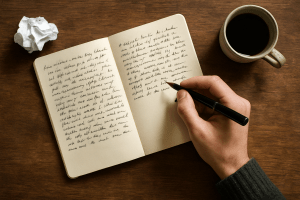
There’s a particular kind of paralysis that creeps in when you stare at a blank page for too long. You’ve got the idea. You’ve got the characters (or at least a whisper of them). You’ve got the mood, the spark, the itch to write. But then your brain, ever so kindly, decides to intervene: “Hang on, where is this story actually going? What if it doesn’t make sense? What if it contradicts itself later? What if it’s just rubbish?”
And just like that, the page stays blank.
I want to talk about a way through that: discovery writing. Some people call it “pantsing” (as in, writing by the seat of your pants), but I prefer discovery writing. It sounds less chaotic and more like what it really is—uncovering a story that already exists, bit by bit, rather than meticulously building one with blueprints and scaffolding.
What Discovery Writing Actually Is
At its heart, discovery writing is the act of trusting yourself to find the story as you go. Instead of working out every beat, every twist, every character arc before you write the first sentence, you let the act of writing guide you. It’s like going for a walk without a map: you don’t know exactly where you’ll end up, but you’ll see some interesting sights along the way.
Some writers thrive on outlines, detailed scene breakdowns, character dossiers, and chapter summaries. And that’s great. But for many of us, outlines can become cages. If you’ve ever felt suffocated by your own plan, discovery writing might be the antidote.
It’s certainly the way I tend to write. Almost everything I’ve finished—short stories, scripts, novels—has begun with nothing more than a fragment: a line of dialogue, an image in my head, or even just a half-formed feeling. I start writing and let the thing unravel in front of me. Sometimes the result is neat and sharp. More often, it’s scrappy and sprawling. But here’s the point: if I’d waited until I’d “figured it out” before starting, I probably wouldn’t have written it at all.
The Beauty of Trusting Instincts
There’s something wonderfully freeing about not knowing what happens next. You’re in the same position as your reader: curious, slightly off-balance, wanting to turn the page to find out more. When you write this way, you lean on instinct. A half-formed thought can turn into a scene. A stray line of dialogue can become a character’s entire personality.
For me, this has often led to moments of pure surprise. I’ll be typing away and suddenly a character will do something I didn’t plan—slam a door, confess a secret, reveal a piece of their past; and suddenly the story changes course. That’s not me being clever; that’s me allowing instinct to have the wheel for a while.
One time, I wrote a scene where a character walked into a crime scene, it was just a single sentence. Three chapters later, and I had a protagonist, an antagonist and the beginning of a world. That’s discovery writing in action.
The Messy Middle (and Why It’s Fine)
Let’s be honest: discovery writing is messy. Characters change names halfway through. Timelines don’t quite line up. You write yourself into corners that require a clumsy rope ladder to escape. If you’re used to neatness and order, this can be deeply uncomfortable.
But here’s the thing: first drafts are meant to be messy. Whether you outline or not, you’ll always face revisions. Discovery writers just lean into that truth early. Instead of trying to avoid the mess, you accept it, maybe even revel in it.
When I look back at my drafts, I can often see the exact point where I got lost and had to write my way back out. Sometimes the story meanders, doubling back on itself, but in those detours, I find the real heart of it. It’s almost like wandering around a city without a guidebook; you might miss the “official landmarks,” but you’ll stumble across hidden cafés and backstreets you never would have found otherwise.
How to Silence the Overthinking Voice
Overthinking is the enemy of discovery writing. That voice in your head wants to analyse every choice, weigh every option, and make sure you don’t waste your time. But art is never a waste, and writing is often about the tangents, the detours, the blind corners you couldn’t have predicted.
A few tricks that help me:
- Write fast. The faster you write, the less room your brain has to get in the way. I sometimes set a timer and just go until it dings.
- Don’t delete. Even if a scene feels wrong, let it sit. You might need it later, or it might reveal something you didn’t expect.
- Give yourself permission to be bad. This is the hardest part. If you can accept that not everything you write will be gold, you’ll unlock the freedom to keep going.
- Treat it like play. The less pressure you put on the writing, the more likely it is to surprise you.
When Instinct Betrays You
Of course, trusting instincts doesn’t always lead somewhere good. Sometimes you’ll hit a dead end. Sometimes you’ll reread what you wrote and think, What on earth was I doing?
I’ve had entire drafts that went nowhere, abandoned halfway through because the story fizzled out. At first, I saw that as failure. But over time, I realised that even those “lost” drafts had value. They taught me something about the characters, the world, or even just the mood I wanted to capture. Sometimes I’ve plucked a single line from a dead project and built something completely new around it.
Instincts improve with practice, just like any skill. The more you write, the sharper your sense becomes of when a story is flowing and when you’re forcing it. And the wrong turns? They’re not wasted—they’re experiments. They show you what doesn’t work, and sometimes, in showing you that, they open the door to what does.
Why It’s Worth Trying
Discovery writing is not about producing a flawless draft—it’s about letting yourself enjoy the act of writing. It’s about curiosity. It’s about rediscovering why you fell in love with storytelling in the first place.
The best stories, the ones that feel alive, often have that raw, unplanned energy in them. They surprise even the author. And when you’re surprised, chances are your readers will be too.
For me, this approach has become second nature. It’s not always tidy, and it certainly doesn’t guarantee smooth sailing, but it keeps me writing. It keeps me curious. And more than anything, it keeps me from staring at the blank page, paralysed by possibilities.
So if you’ve been stuck, waiting for the “perfect plan” before you start, maybe give yourself permission to skip the plan. Just start writing. Trust the instinct, trust the moment, and see where it takes you.
You might not end up where you thought you were going. But that’s the art of it. That’s discovery writing.
 Gareth Ellis - Author